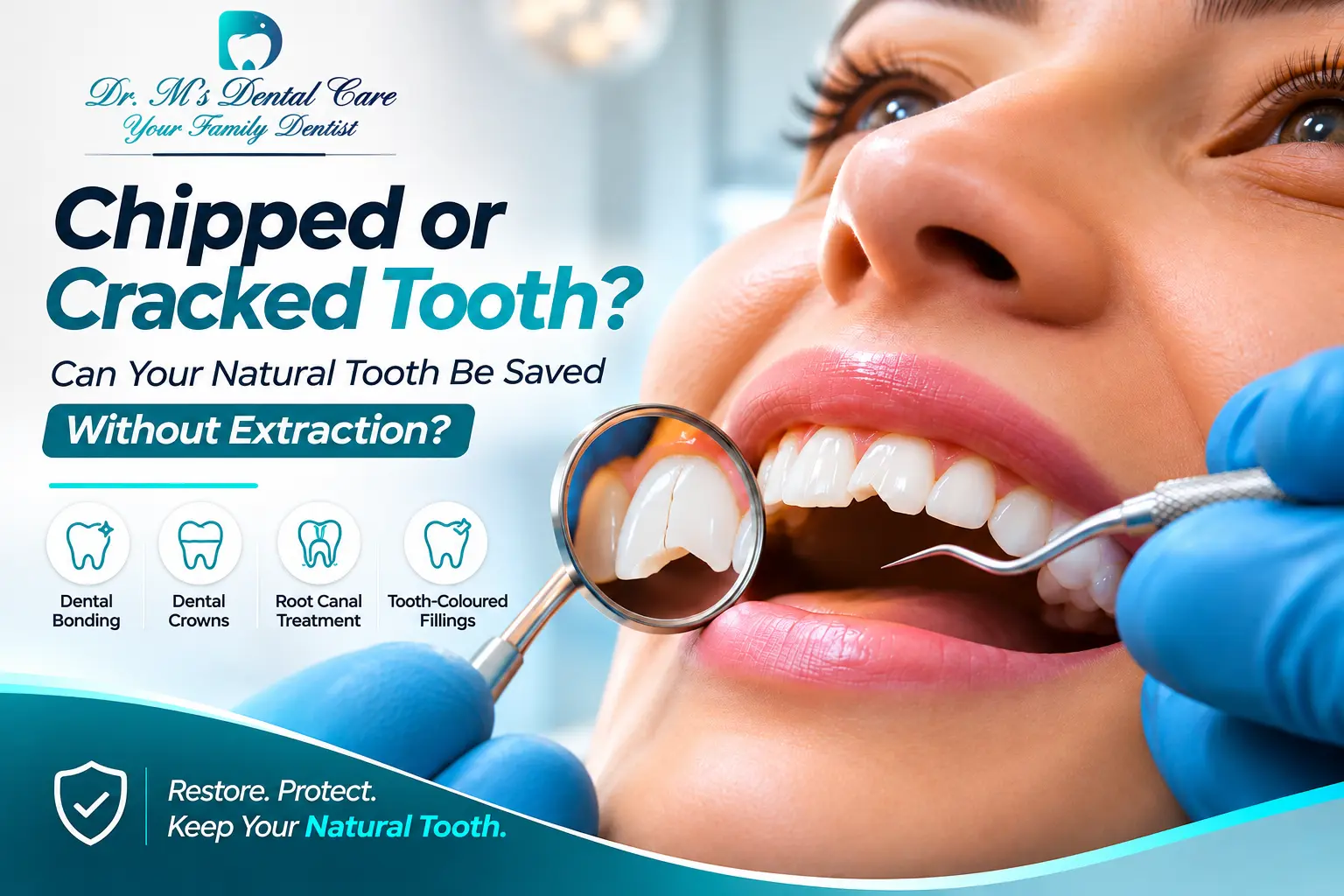
Yes, a chipped or cracked tooth can often be repaired without extraction, depending on the severity and location of the damage. Treatments such as tooth-coloured fillings, dental bonding, crowns, and root canal treatment may help preserve the natural tooth. Early dental evaluation is essential to determine the right approach.
Key Takeaways
- Not every chipped or cracked tooth requires extraction.
- Minor chips can often be repaired using tooth-coloured fillings or bonding.
- Dental crowns may protect teeth with more extensive structural damage.
- Root canal treatment may help save a cracked tooth when its inner pulp is affected.
- Cracks extending below the gum line may make a tooth impossible to save.
- Early diagnosis can help prevent further damage.
- Professional dental assessment is important before choosing any treatment.
What Causes a Tooth to Chip or Crack?
Teeth are strong, but they are not indestructible. Everyday habits, injuries, and certain dental conditions can weaken tooth structure and cause cracks or fractures.
Some damage happens suddenly, while other cracks develop gradually without obvious symptoms.
1. Biting Hard Foods
Chewing ice, hard candies, nuts, or unpopped popcorn kernels can put excessive pressure on teeth. This may cause small chips or larger fractures, particularly in teeth that already have weakened areas.
2. Accidental Injuries
Falls, sports injuries, road accidents, or accidentally hitting your mouth against a hard surface can damage your teeth.
Front teeth are particularly vulnerable because they are more exposed during facial injuries.
3. Teeth Grinding and Clenching
Repeatedly grinding or clenching your teeth, especially during sleep, places continuous pressure on the enamel. Over time, this pressure may contribute to cracks and weakened tooth structure.
4. Large Fillings and Previous Dental Work
Teeth with extensive fillings or previous restorations may have less remaining natural structure. This can make certain teeth more vulnerable to fractures.
5. Untreated Tooth Decay
Deep cavities weaken the natural tooth structure. If left untreated, decay can make the tooth more likely to break during normal chewing.
What Are the Signs of a Chipped or Cracked Tooth?
Not every damaged tooth causes immediate pain. Dentists may find some cracks difficult to identify without a proper dental examination.
Watch for these common symptoms:
- Sharp pain when biting or chewing.
- Sudden sensitivity to hot or cold drinks.
- A rough or uneven tooth edge.
- Visible cracks or missing pieces of enamel.
- Discomfort when releasing biting pressure.
- Swelling around the affected tooth.
- Intermittent toothache without an obvious cause.
Important: Pain that comes and goes does not mean the crack is harmless. If you notice these symptoms, arrange a dental assessment rather than waiting for the discomfort to become severe.
According to the American Association of Endodontists’ guide to cracked teeth, cracked teeth can produce inconsistent symptoms, including pain during chewing and sensitivity to temperature changes.
Can a Cracked Tooth Be Saved Without Extraction?
In many cases, yes. A dentist may be able to preserve a damaged natural tooth through restorative treatment.
However, the outcome depends on several factors:
- How deep the crack extends.
- Whether the tooth pulp is affected.
- Whether the fracture reaches below the gum line.
- How much healthy tooth structure remains.
- Whether infection or significant surrounding damage is present.
For example, a small enamel chip may require only minor restoration, while a deeper fracture could need root canal treatment and a protective crown.
According to the American Association of Endodontists, preserving a natural tooth is worth considering whenever clinically possible.
However, extraction may be necessary when the tooth is split or the fracture extends too far below the gum line.
Treatment Options for Chipped and Cracked Teeth
The best treatment depends on the type and severity of the damage. Here are some common options a dentist may recommend.
1. Tooth-Coloured Dental Fillings
<Tooth-coloured fillings> are commonly used for small chips and minor structural damage.
A dentist applies a tooth-coloured restorative material to rebuild the missing portion and improve the tooth’s appearance.
Suitable for:
- Small chips in the enamel.
- Minor fractures.
- Limited areas of tooth damage.
- Certain front tooth repairs.
The dentist carefully shapes the material to match the surrounding tooth.
Dr. M’s Dental Care offers tooth-coloured dental fillings as part of its restorative dental services.
2. Dental Bonding
Dental bonding uses a tooth-coloured composite resin to repair minor imperfections.
It can improve the appearance of a chipped front tooth and restore its shape without necessarily requiring a more extensive restoration.
Benefits may include:
- Improving the appearance of chipped teeth.
- Restoring small damaged areas.
- Matching the colour of surrounding teeth.
- Preserving more natural tooth structure than some extensive restorations.
Bonding is not suitable for every fracture. A dentist must first assess whether enough healthy tooth structure remains.
3. Dental Crowns for Cracked Teeth
A dental crown is a custom-made covering that fits over a prepared tooth.
It helps protect weakened tooth structure and restore its shape, appearance, and chewing function.
A crown may be recommended when:
- A large portion of the tooth has broken.
- A tooth has a significant fracture.
- A tooth needs additional protection after root canal treatment.
- A previous large restoration has weakened the remaining structure.
Dr. M’s Dental Care provides crowns and bridges to restore damaged teeth and improve their function.
4. Root Canal Treatment
What happens if a crack reaches the inner part of your tooth?
The pulp contains nerves and blood vessels. If the crack damages or infects this tissue, root canal treatment may be necessary.
During the procedure, the dentist removes the affected pulp, cleans and seals the root canal system, and restores the tooth with an appropriate filling or crown.
Root canal treatment may help when:
- The tooth pulp becomes infected.
- A deep crack affects the inner tooth structure.
- The tooth remains structurally restorable.
- The surrounding root and supporting tissues are suitable for treatment.
You can learn more about root canal treatment at Dr. M’s Dental Care.
5. When Is Tooth Extraction Necessary?
Although dentists generally consider preserving natural teeth when possible, some fractures cannot be repaired successfully.
Extraction may be necessary when:
- The tooth is split into separate sections.
- The fracture extends significantly below the gum line.
- The remaining tooth structure cannot support a restoration.
- Severe infection or damage makes the tooth unrestorable.
Your dentist will examine the affected tooth and explain whether restoration or extraction is the safer option.
Chipped Tooth vs Cracked Tooth: What’s the Difference?
Although these terms are sometimes used interchangeably, they describe different types of dental damage.
| Feature | Chipped Tooth | Cracked Tooth |
|---|---|---|
| Damage | Small piece of tooth breaks away | A fracture develops within the tooth |
| Appearance | Often visibly uneven | May be difficult to see |
| Pain | Sometimes painless | May hurt during chewing |
| Sensitivity | Possible | Common in some cases |
| Treatment | Bonding or filling | Filling, crown or root canal, depending on severity |
A dental examination is necessary to identify the exact type of damage.
What Should You Do Immediately After Breaking a Tooth?
If your tooth suddenly chips or breaks, taking the right steps can help protect it until you reach a dentist.
- Rinse your mouth gently: Use lukewarm water to clean the affected area.
- Save the broken piece: If you can find the fragment, keep it in milk or saliva and take it to your dentist. In some cases, the dentist may be able to reattach it.
- Avoid hard foods: Do not chew on the damaged side.
- Protect your mouth: If the broken edge is sharp, dental wax may temporarily cover it.
- Arrange a dental appointment: Have the damage assessed as soon as possible.
Do not attempt to glue the broken piece back yourself or use household adhesives.
For further guidance, read the NHS advice on chipped, broken or cracked teeth.
When Should You See a Dentist Immediately?
Some dental injuries require urgent attention.
Contact a dentist promptly if you experience:
- Severe or persistent tooth pain.
- Significant swelling around the tooth or gums.
- A deep fracture with visible inner tooth tissue.
- Bleeding that does not stop.
- A tooth that becomes loose or moves out of position.
- A completely knocked-out permanent tooth.
A knocked-out permanent tooth is a dental emergency and needs immediate professional attention.
If you have serious facial injuries, uncontrolled bleeding, or severe swelling affecting breathing, seek emergency medical assistance.
Where Can You Get Chipped or Cracked Tooth Treatment in Karachi?
If you are looking for chipped or cracked tooth treatment in Karachi, choosing a dental clinic with restorative and endodontic expertise is important.
Dr. M’s Dental Care is located in DHA Phase 8, Karachi, and offers several treatments relevant to damaged teeth, including:
- Tooth-coloured dental fillings.
- Root canal treatment.
- Dental crowns and bridges.
- Restorative dental care.
- Dental examinations and diagnostic services.
Dr. Syed Masood ul Hasan is a Restorative Dentistry Specialist and Endodontist. You can learn more about Dr. Masood and his professional background.
Patients looking for a restorative dentist in Karachi can contact the clinic to discuss their dental concerns and arrange an examination.
Visit Dr. M’s Dental Care to learn more about its dental services.
How Can You Prevent Chipped and Cracked Teeth?
Although not all dental fractures can be prevented, a few everyday habits may reduce your risk.
- Avoid chewing ice and extremely hard objects.
- Do not use your teeth to open packages or bottles.
- Wear a mouthguard during contact sports.
- Discuss a night guard with your dentist if you grind your teeth.
- Treat cavities before they weaken the tooth structure.
- Maintain regular dental examinations.
- Avoid biting hard objects with already damaged teeth.
Prevention and early treatment can help protect your natural teeth for longer.
Don’t Let a Cracked Tooth Get Worse!
Your natural tooth may still be saved with the right dental treatment. Get your damaged tooth examined by a dental professional and explore suitable restoration options at Dr. M’s Dental Care.
Dr. M’s Dental Care | DHA Phase 8, KarachiFinal Thoughts
A chipped or cracked tooth does not automatically mean you need an extraction. Depending on the damage, treatments such as dental bonding, tooth-coloured fillings, crowns, and root canal treatment may help preserve your natural tooth.
The most important step is getting an early dental examination. If you are experiencing tooth damage or discomfort, consult a qualified dentist to understand your treatment options.
For professional dental care in DHA Karachi, contact Dr. M’s Dental Care and arrange a consultation.
Frequently Asked Questions
No. Unlike bones, cracked teeth cannot naturally heal themselves. However, professional dental treatment may repair and protect the damaged tooth, depending on the location and severity of the fracture.
Yes. Minor chips can often be repaired using dental bonding or tooth-coloured fillings. Larger areas of damage may require a dental crown. The appropriate treatment depends on how much healthy tooth structure remains.
The best treatment depends on the depth and location of the crack. Minor damage may need bonding or fillings, while deeper fractures may require a crown or root canal treatment.
No. Root canal treatment is generally needed when the crack affects the tooth pulp and causes inflammation or infection. Minor cracks that do not affect the pulp may be treated with other restorative options.
The cost depends on the extent of damage and the treatment required. Dental bonding, fillings, crowns, and root canal treatment have different costs. A dental examination is necessary to receive an accurate estimate.
Sometimes. A dentist may restore a damaged front tooth using bonding, a filling, a crown, or root canal treatment if necessary. However, a severe fracture extending below the gum line may make restoration impossible.
An untreated crack may become deeper and allow bacteria to reach the inner tooth. This can lead to pain, infection, and further structural damage. Early dental assessment helps determine the best way to protect the tooth.
Dr. M’s Dental Care in DHA Phase 8, Karachi, offers restorative dental services, including tooth-coloured fillings, crowns, and root canal treatment. Contact the clinic to arrange an examination and discuss suitable treatment options.